
Richland County Parole and Probation
The South Carolina Department of Probation, Parole and Pardon Services Offender Search is the main public route for a person supervised in Richland County. The agency is commonly called SCDPPPS or PPP. Its records cover several legal statuses, so the label on an individual result matters. A person on parole has moved from a state prison sentence into conditional community supervision. Probation is imposed by a court, sometimes instead of prison and sometimes after a suspended part of a sentence. Someone released from Alvin S. Glenn Detention Center on an appearance bond may have neither status.
Community supervision is also a specific statutory category for some no-parole offenses. Supervised reentry is another PPP label. These terms should not be collapsed into “parole.” Each has its own authority, duration, and conditions. The comparison shows why a custody release and a supervision record answer different questions.
| Status | How it begins | Best confirmation |
|---|---|---|
| Parole | The Board authorizes conditional release from an SCDC prison sentence. | PPP Offender Search, the Board result, and the Richland County office. |
| Probation | A court orders supervision, with or without an earlier period in custody. | PPP Offender Search and the sentencing court record. |
| Community supervision | State law requires a supervision period tied to certain no-parole offenses. | The exact PPP status and governing sentence record. |
| Supervised reentry | PPP records the person under its named reentry supervision category. | The individual PPP result and county office. |
- Parole
- Conditional community release from a prison sentence.
- Probation
- Court-ordered supervision that may begin without a prison term.
- Discharge
- The formal end of the supervision obligation.
- Absconder
- A person whom PPP alleges has stopped reporting or cannot be found as required.
Verify Richland County Post-Release Supervision
Begin with identifiers, not a guess based on the person’s release. The PPP search accepts specified combinations: first and last name; SID; first name and birth year; last name and birth year; county with SID; county with first name; or county with last name. Open the individual name when the system returns several matches. Compare the identity and supervision details before treating the result as the right person. PPP says its online information reflects the prior day, so a change made today may not appear yet.
- Open the official PPP Offender Search and enter one of its accepted field combinations.
- Choose Richland only when it is the relevant county of supervision. Do not assume the release facility controls that field.
- Open the matching individual record and copy the exact supervision label. Distinguish parole, probation, community supervision, and supervised reentry.
- Check the sentencing court when probation terms or the legal basis need confirmation. A court order can remain public after the jail roster changes.
- Call the Richland County PPP office for a same-day status question because the web data is a previous-day snapshot.
A positive result supports an active or recent supervision relationship. A blank result has narrower meaning. PPP warns that someone no longer under supervision may not be listed, so absence does not disprove an earlier release, parole term, or probation sentence. For the custody event itself, use the Richland County released-inmate search and records path. That record can show when county custody ended, while PPP shows what supervision followed.
The official supervision interface is visible in the PPP Offender Search captured for this project.
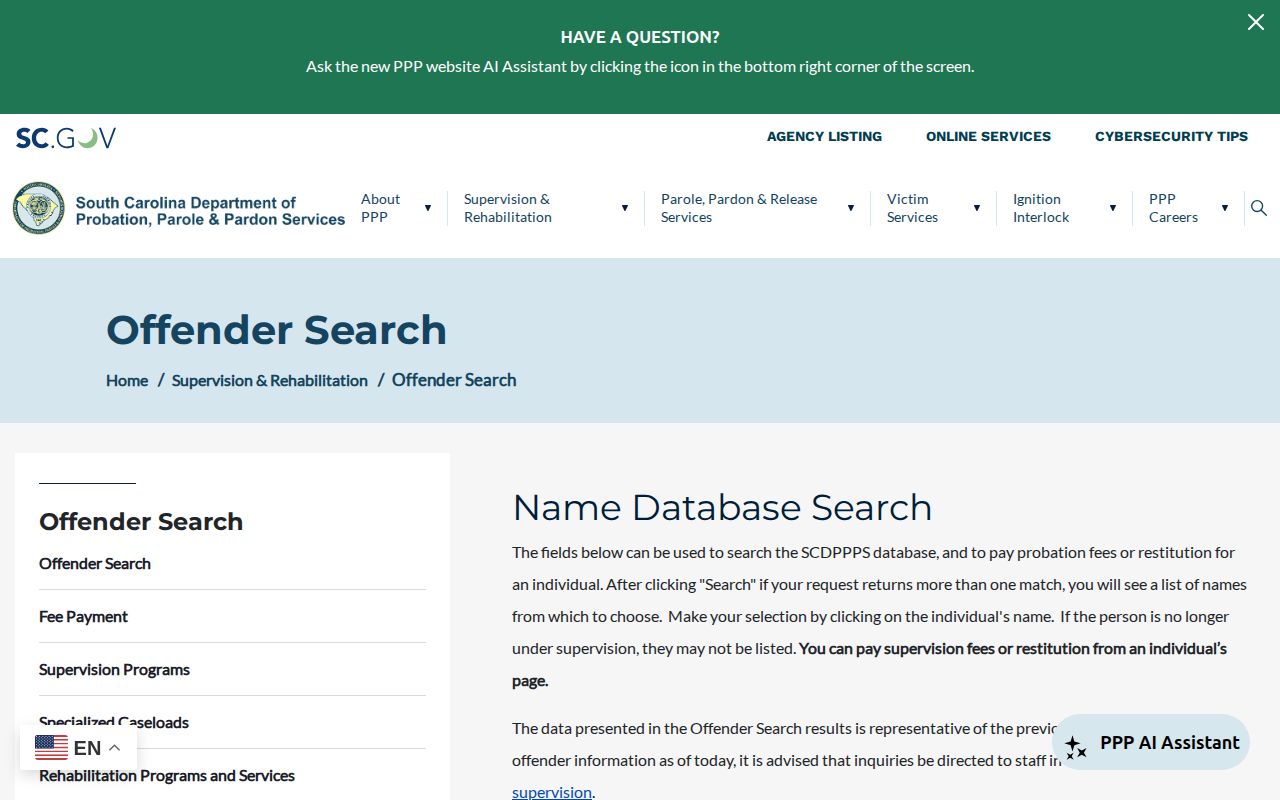
Its field combinations and prior-day timing make careful matching and a county-office check essential for current Richland County supervision.
Note: A PPP match confirms supervision, not the exact time a person left Alvin S. Glenn or an SCDC institution.
Richland County Supervision Office Details
The official Richland County PPP office page supplies the local route when the online record is stale, unclear, or missing a same-day update. County of supervision is the key. It may differ from the county where someone was held, convicted, or released. State staff can confirm what the agency may disclose and direct the caller to the appropriate office if supervision belongs elsewhere.
SCDPPPS Richland County
300 Columbia Mall Boulevard, Suite 110
Columbia, SC 29223
803-734-6320
Fax: 803-734-0020
Mail: P.O. Box 906, State Park, Columbia, SC 29203
The county page also publishes category counts for its jurisdiction. On July 27, 2026, it listed 2,054 probation cases, 156 parole cases, 156 community-supervision cases, 35 supervised-reentry cases, 86 Jessie’s Law tracking cases, and no supervised-furlough cases. They are point-in-time jurisdiction counts, not a release tally. Categories should not be added and described as a count of unique people without agency confirmation.
The project’s image of the Richland County PPP directory entry shows why the county page is more useful than a statewide switchboard.
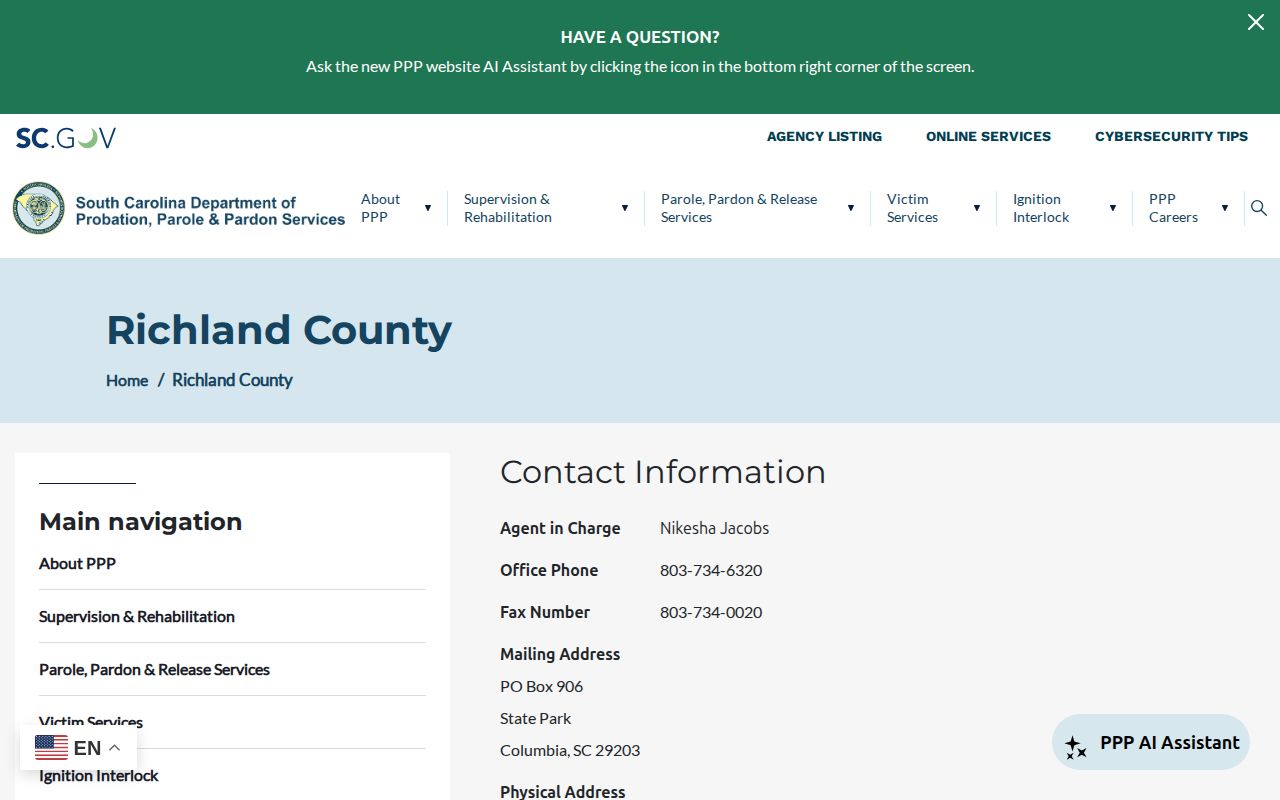
The office address, direct phone, and jurisdiction figures provide a local check when the prior-day search has not caught up.
Richland County Parole Hearing Results
A parole hearing is not the same as release. The seven-member South Carolina Board of Paroles and Pardons decides state parole matters. Its Board page links the current annual calendar and archived meeting minutes. Person-specific hearing dates are generally finalized about 30 days beforehand. Dates can move, and posted results can lag, so the individual search should be checked again near the expected session.
The Parole Hearing Search accepts first and last name, SCDC number, first name plus hearing month, last name plus hearing month, or month alone. A “granted” result authorizes parole subject to the order, conditions, approved plan, detainer review, and release processing. It is not a gate time. A denial means prison custody continues. A deferred or rescheduled matter has no final grant from that session, while rescinded or revoked status means an earlier authorization or parole status was withdrawn through the governing process.
South Carolina Code Title 24, Chapter 21 supplies the legal framework. Section 24-21-620 contains a general one-fourth review rule for qualifying sentences, Section 24-21-635 addresses earned-work credits in eligibility, and Section 24-21-640 states decision criteria and limits. Offense-specific and no-parole rules can override the general path. Violent-offense decisions require the statutory Board vote, and a denial may place later review on a different cycle. Do not calculate eligibility from one fraction alone.
Richland County Supervision Violations
Supervision conditions come from the controlling court order, parole order, and PPP instructions. They can include reporting duties, approved residence or travel terms, program participation, payment duties, and compliance with the law. The precise terms belong to the individual record. A general agency page cannot establish whether a certain act violated one person’s order. Use the written terms and ask the assigned office when the wording is unclear.
An absconder is not the same as an escapee. The term means PPP alleges the supervised person stopped reporting or cannot be located as required. That allegation may lead to a warrant, violation report, arrest, or revocation process, but it does not erase the fact that the person was first released. No official Richland County public absconder list was found in the research sweep. Confirm a claimed warrant through PPP and the court or law-enforcement office responsible for it.
SC VINE can provide a separate status or notification layer for county detention, SCDC custody, and PPP supervision. It is useful after an arrest or custody change, but it is not the official supervision case file. Transfers between agencies can require a new registration. The agency record and final order remain the sound sources for a violation or discharge decision.
Note: Social posts and commercial listings do not establish a Richland County warrant, absconder status, or a final supervision decision.
Richland County Reentry Before Release
Richland County has a distinct state-prison reentry link. Manning Reentry/Work Release Center in Columbia is SCDC’s centralized male pre-release institution for people within 180 days of return to their communities. That placement is a planning marker, not a promised release date. A resident remains in SCDC custody until final authorization, records checks, and the actual release event are complete.
SCDC lists family reunification, peer support, medication-assisted treatment, and pre-release preparation among Manning’s programs. These services provide context for a transition into parole, community supervision, or another lawful status. They do not show what any one person received or guarantee an outcome. After release, the PPP Offender Search and Richland office are the routes for confirming an active supervision category. SCDC’s released search and inmate records answer the separate question of when prison custody ended.
How Richland County Supervision Ends
Supervision ends through formal discharge, expiration, a court or Board action, or another authorized case outcome. Discharge means the supervision duty has ended. It should not be inferred from a person disappearing from the online PPP search because that system excludes people no longer supervised and reports prior-day information. Obtain the final order or agency confirmation when the end date matters.
Keep the custody and supervision records paired but distinct. Alvin S. Glenn records establish a county-jail release or transfer. The SCDC Released Inmate Search documents a state-prison release. A court docket shows probation terms and later orders. PPP supplies the community-supervision relationship and its end. Together, those sources can explain the sequence without treating a parole hearing, a web absence, or a change of facility as proof of community release.