
Kirkland Reception Transfer Outcomes
Kirkland opened in 1975 and serves as the reception and evaluation center for male offenders age seventeen and older who are sentenced to ninety-one days or more. SCDC reports about 8,000 receptions through its combined process each year. Those figures describe intake volume, not releases. Classification assigns the next institution through the statewide system.
Kirkland also has maximum-security and medical functions. A departure can be routine assignment, a security change, medical movement, court transport, or transfer elsewhere in SCDC. These are not community exits. Richland County JMS cannot track the person because Kirkland is a state institution. The current SCDC locator is the first and strongest test.
| Observed change | Custody meaning | Correct check |
|---|---|---|
| Still at Kirkland | Current SCDC incarceration | SCDC current search |
| New SCDC institution | State custody continues | Current statewide detail |
| Released entry | SCDC recorded a state-prison exit | Released Inmate Search |
| PPP entry | Community supervision is active or recent | SCDPPPS Offender Search |
Confirm Kirkland Custody Changes
Begin with the SCDC current Inmate Search. It accepts SCDC ID, SID, first and last name, and a phonetic option. Its official disclaimer says the data reflect the previous midnight and exclude released offenders. A current match can show the prison placement and public sentence information. A failed match is expected after discharge, but it can also reflect spelling, timing, or another data issue.
For an actual past exit, change to the SCDC Released Inmate Search. This tool requires a from and to date plus a county selection. It returns ten results at a time and offers Export. Match the SCDC ID rather than relying on a name alone. The form's County field should not be described as a residence address unless the export itself supports that reading.
- Search the current SCDC system for present statewide custody.
- Choose a plausible date range in the released-person system.
- Review each page or Export and match the SCDC number and identity facts.
- Record the release date and exact release-type label.
- Check SCDPPPS if a parole or community-supervision phase could follow.
Kirkland Transfer Record Fields
The statewide released product documents identity and the SCDC event. Publicly described fields include SCDC number, name, sex, race, age, release date, release type, and county. Export can supply more detail. These values help distinguish people with similar names and preserve the agency's own wording. Do not replace an official release type with a guess about where the person went.
A supervision record answers a different question. The South Carolina Department of Probation, Parole and Pardon Services can show parole, probation, community supervision, or supervised reentry. Its public data represent the previous day, and a person no longer supervised may disappear. Thus a positive record supports a community phase, while a no-match does not disprove an older release.
- Discharge
- The recorded end of a custody or sentence phase according to the agency record.
- Parole
- Board-authorized conditional release from prison under supervision.
- Transfer
- A move between custodians or institutions that is not community release.
- Detainer
- Another authority's request or notice that may affect the final destination.
Kirkland Release Documentation
When the online row is not enough, contact SCDC Inmate Records at 803-896-8531 for sentence-calculation questions. A public-record request may seek the nonexempt release document, movement history, sentence computation, or other identified record. Supply the full name, SCDC number, narrow date span, and the exact record wanted. SCDC's FOIA address is FOIA@doc.sc.gov, and the mail route is FOIA Coordinator, Office of General Counsel, P.O. Box 21787, Columbia, SC 29221-1787.
SCDC publishes charges of $18.95 per hour for search, retrieval, and redaction, $0.10 per black-and-white page, and $0.25 per color page, subject to lawful adjustment. Ask for an electronic copy and a cost estimate above a set limit. A sentencing court owns its judgment and later orders, but SCDC owns the state custody movement and final release processing.
The release record should be read with any detainer, approved plan, victim-notification step, and receiving-agency information. A parole grant is authorization, not an exact gate time. The actual SCDC record establishes when processing ended.
Kirkland Records Contact
The institution phone can route questions about its own operations, while centralized SCDC offices handle formal sentence and release records. Current directory details should be checked before travel because institutional operations and contacts can change.
Kirkland Reception and Evaluation Center4344 Broad River Road
Columbia, SC 29210
803-896-1521
Operator: South Carolina Department of Corrections
Men's reception and evaluation center
SCDC headquarters uses P.O. Box 21787, Columbia, SC 29210, and 803-896-8500. Neither the Richland County Detention Center nor the Richland County Sheriff's Department can certify a Kirkland state-prison movement or discharge.
Kirkland Release Cluster Assignments
Angle L centers on Kirkland's role. Richland County contains six SCDC institutions, and Kirkland is the male gateway into that statewide network. A newly sentenced man may appear at Kirkland, complete evaluation, and then move to Broad River, Manning, or an institution outside the county. The disappearance is usually evidence of classification working as designed.
Graham performs the female reception role. Manning is the centralized male pre-release site. Broad River and Broad River Secure serve different custody needs. Because all are near one another, geography can obscure legal status. The SCDC number links the person across those transitions and is safer than matching by institution or name alone.
The official SCDC institutions directory supplies the Richland filter and facility roles. It should be used for context, not treated as a release list.
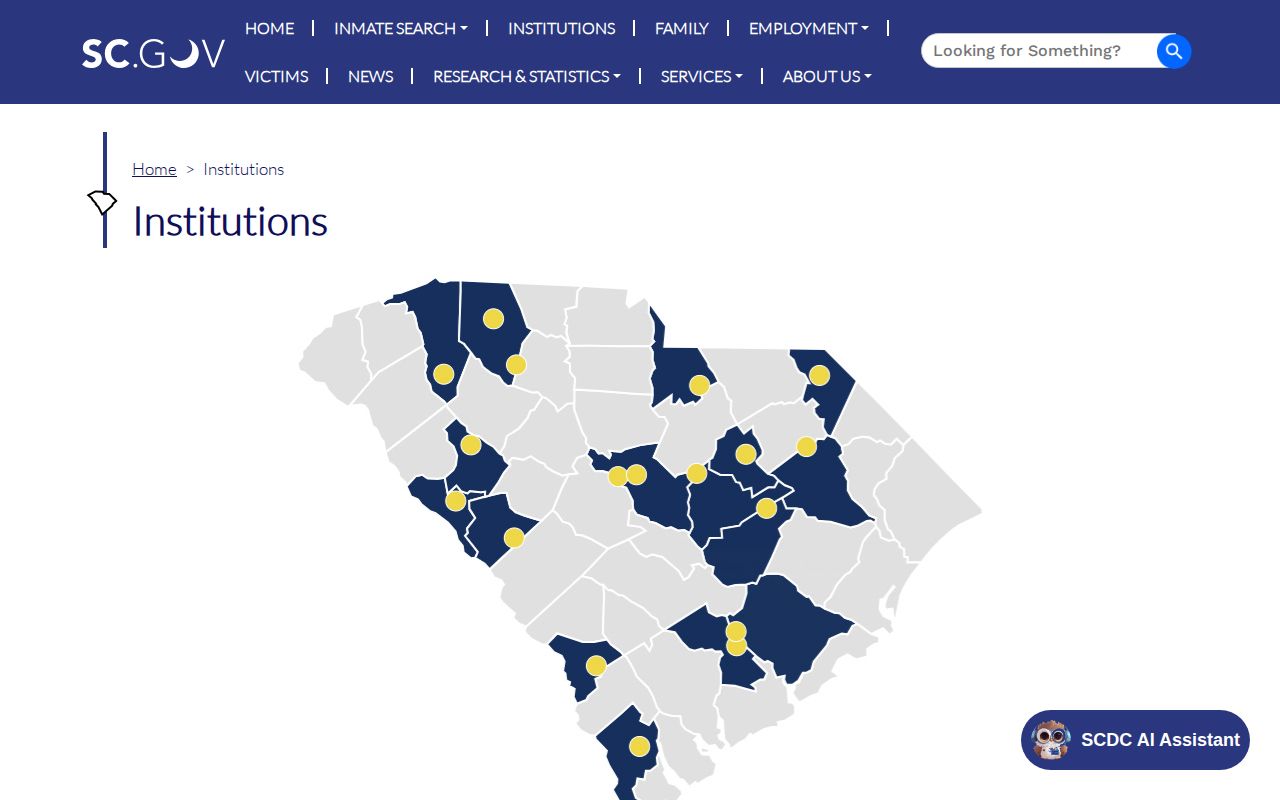
The directory image illustrates why the legal custodian and statewide identifier matter more than a Columbia street address.
Kirkland Discharge Processing
SCDC policy OP-21.09 governs actual release records and procedures. Normal state-prison release hours are 8 a.m. to 5 p.m. each day. Those hours do not apply to routine classification transfers in the same way, and they do not promise a named person will leave at a set hour. Staff must complete authorization, records checks, detainer review, required documents, and other final tasks for a true discharge.
Transportation also follows the state framework. When transportation has not otherwise been provided, policy describes an in-state bus ticket to the home or family of record under its conditions. This does not establish a particular pickup point or destination for any one release. Direct logistical questions to SCDC before travel.
Property, final documents, and notification steps are part of processing. If a scheduled date passes, check Inmate Records rather than assuming the person is in the community. A detainer, amended sentence, loss of credit, or pending authorization can change the outcome.
Kirkland Release Evidence
Strong confirmation usually combines several records. The released list proves SCDC recorded an exit. SCDPPPS can show a supervision phase after confinement. A court docket supplies the sentence and later orders. SC VINE may report a custody change but can lag, and agency transfers can require registration again.
Keep the four moments distinct: an estimated date, parole eligibility, legal authorization, and actual physical release. An estimated date may change. Eligibility means a decision-maker may consider release. A grant can still require conditions and processing. Actual release is the event that belongs in the released record.
For a wider comparison of county-jail and state-prison routes, the Richland County release-record search explains how the systems fit together. A Kirkland departure stays on the SCDC track unless the released record or named receiving custodian proves otherwise.
Kirkland Reception Movement Records
A Kirkland movement record can be more useful than a release search when a newly sentenced man disappears from the reception center. Ask for the admission date, SCDC number, classification movement date, prior and receiving institutions, and movement type. These fields show whether routine assignment explains the change. They also reduce confusion when a current locator updates after the person has arrived elsewhere.
The sentence threshold in the institution description helps classify the record. Kirkland receives men age seventeen and older sentenced to at least ninety-one days. That role differs from Alvin S. Glenn, which holds pretrial defendants and some local sentenced adults. A person transferred from the county jail into Kirkland has left County custody but has not entered the community. The SCDC current locator becomes the correct live source once state admission is processed.
True discharge still follows the standard state route. Search the released list across the probable date range, match the SCDC ID, and record the exact release type. Do not substitute a parole grant or estimated date for the actual released entry. Eligibility, hearing, authorization, and release are separate moments. SCDPPPS supplies the later community-supervision record, while SCDC Inmate Records explains the official sentence calculation and final movement.